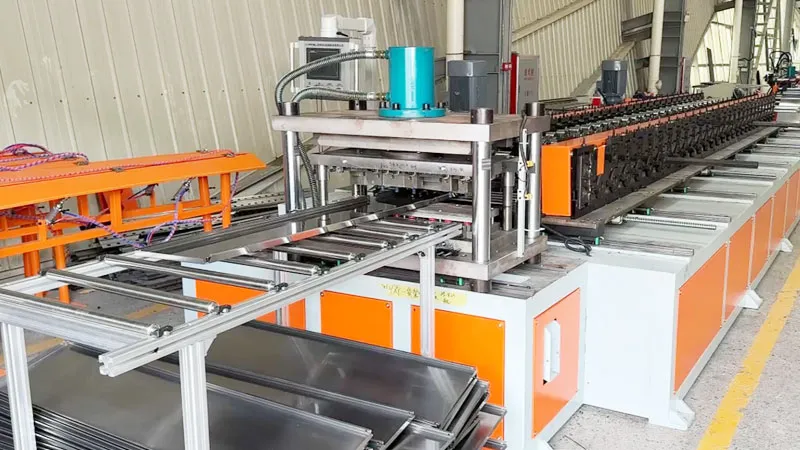
Roll Forming Production Line for High-Efficiency Metal Profile Manufacturing
Feb 09, 2026
Read:1148
Source: Armdax
In today’s highly competitive manufacturing industry, efficiency, consistency, and cost control are more important than ever. A roll forming production line has become one of the most reliable and widely used solutions for producing long, uniform metal profiles with high precision and minimal material waste.
From construction and shelving systems to automotive components and solar mounting structures, roll forming technology plays a critical role in modern industrial production.
What Is a Roll Forming Production Line?
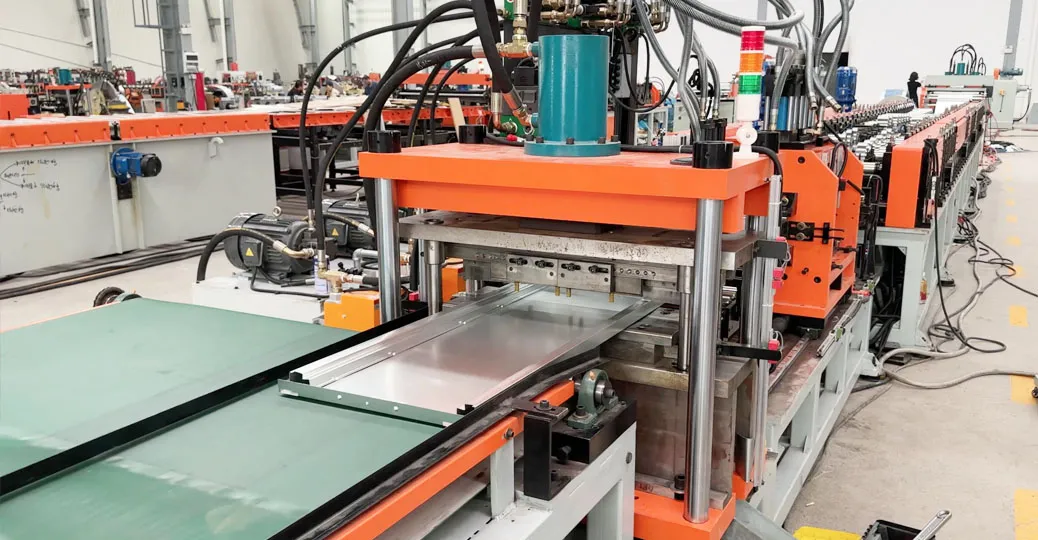
A roll forming production line is an automated metal forming system that continuously bends flat metal coils into specific cross-sectional profiles through a series of precisely engineered roller stations.
Unlike press forming or stamping, roll forming works gradually, allowing manufacturers to produce complex shapes with:
High dimensional accuracy
Excellent surface quality
Stable repeatability
Continuous, high-speed output
Typical materials include steel, galvanized steel, aluminum, stainless steel, and pre-painted metal coils.
Key Components of a Roll Forming Production Line
A complete roll forming production line usually consists of the following parts:
Decoiler – Automatically unwinds metal coils
Feeding & Leveling System – Ensures smooth and straight material flow
Roll Forming Machine – Multiple forming stations shape the metal step by step
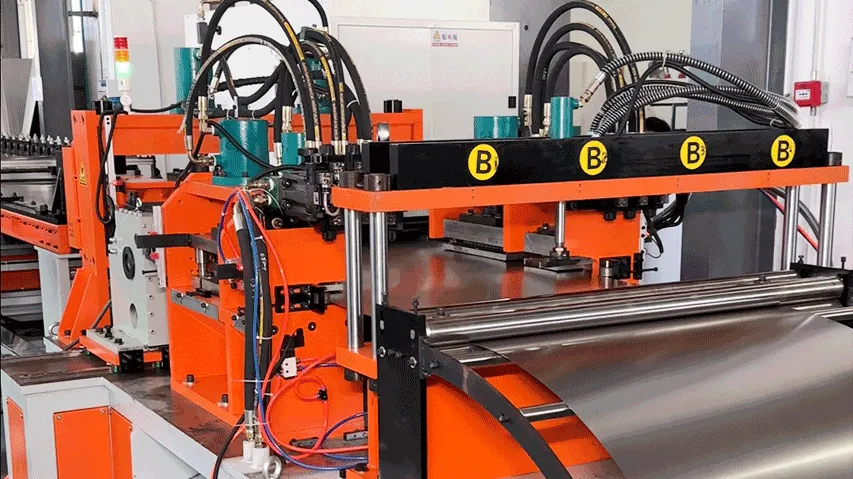
Punching or Cutting System – Hydraulic or servo-controlled punching and cutting
PLC Control System – Fully automated operation and parameter control
Run-Out Table or Stacker – Collects finished profiles efficiently
Each component is designed to work together for maximum productivity and minimal downtime.
Advantages of Using a Roll Forming Production Line
Investing in a roll forming production line offers manufacturers significant advantages:
High Production Efficiency
Continuous operation allows high-speed output, making it ideal for mass production.
Labor Cost Reduction
Automation reduces manual handling and dependence on skilled labor.
Consistent Product Quality
Profiles maintain uniform dimensions across long production runs.
Material Savings
Minimal scrap compared to traditional forming methods.
Flexible Customization
Lines can be designed for roofing panels, purlins, shelving uprights, guard rails, pipes, and more.
Applications of Roll Forming Production Lines
A roll forming production line is widely used across multiple industries, including:
Construction: roofing panels, wall panels, C/Z purlins
Storage & Logistics: shelving systems, pallet racks
Solar Energy: solar mounting structures and rails
Automotive: chassis components, reinforcements
Furniture & Appliances: metal frames, structural parts
This versatility makes roll forming one of the most cost-effective metal forming technologies available.
How to Choose the Right Roll Forming Production Line
When selecting a roll forming production line, manufacturers should consider:
Profile design complexity
Material thickness and type
Required production speed
Automation level
Future expansion needs
After-sales service and technical support
Working with an experienced roll forming machine manufacturer ensures the production line is optimized for long-term performance and scalability.
The Future of Roll Forming Production Lines
With the rise of smart manufacturing and Industry 4.0, modern roll forming production lines are evolving toward:
Servo-driven systems
Intelligent PLC control
Remote diagnostics
Higher precision and faster changeovers
These advancements help manufacturers stay competitive while maintaining high efficiency and product quality.
A roll forming production line is a powerful solution for manufacturers seeking efficient, automated, and cost-effective metal forming. Whether for construction, storage systems, or industrial components, roll forming technology delivers unmatched consistency and productivity.
Choosing the right production line not only improves manufacturing efficiency but also strengthens long-term competitiveness in a demanding global market.
Table of Contents